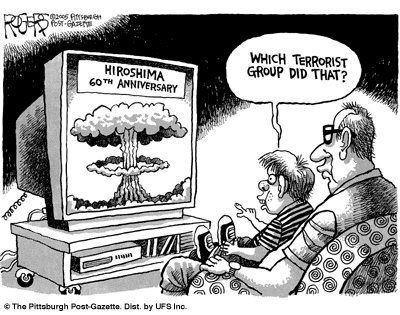
One of Rey Chow's most compelling points in her essay "The Age of the World Target" occurs when she states that the "elimination of the actual physical warring activities has the effect not of bringing war to an end but instead of promoting and accelerating terrorism, and importantly, the terrorism of so-called 'deterrent' weaponry" (Chow 31). I think that this reference to the atomic bombings of Hiroshima and Nagasaki as acts of terrorism is a reference which too often is neglected in discussions of the two acts. The Oxford English Dictionary defines terrorism as "the use of violence and intimidation in the pursuit of political aims." Under this clear and simple definition, it is easy to see Hiroshima and Nagasaki as acts of terror and yet for all of its political influence over the Cold War as a deterrent of violence and even disarmament today, where the deactivation of nuclear weapons is used as a sort of international reputation booster and symbol of a desire for peace, the discussion of Hiroshima and Nagasaki as acts of terror is frighteningly scarce. Chow herself only briefly inserts this discussion into a single paragraph in her essay.
While the conclusions of terrorists as a subjective term and the near immunity that great world powers are granted in terms of violence and destruction are easy to make and very transparent in this point, the fact that Hiroshima and Nagasaki are not readily deemed acts of terrorism also has implications upon the abstraction and understanding of cultural and area studies. Terrorism currently has strong connotations of illegitimate acts of violence and intimidation for political purposes. Terrorism is always a threat that comes from without and is not authorized by any powers who would be allied with the state being attacked. Thus, the alien threats are ones which cannot be understood without seeking the cultural or social roots of the terrorism being perpetrated. By studying another culture based upon the premise of understanding acts of terrorism, that culture is still being viewed as alien and the study becomes an action of self-defense and preemptive and preventative intelligence. This holds acts of terrorism at arms length from the state, distancing such actions from the main government and presenting terrorism as a fringe act, as if utilizing fear and "terror" for political purposes is not something that any legitimate government would ever do. Exploiting fear is only the act of an unfathomable enemy because wanton destruction is uncivilized.

No comments:
Post a Comment